1.Grace of an Activist
Hollywood is not a great resource for support when it comes to antisemitism. While we own the studios and banks (haha) not many stars stand with us on this issue. It is against that backdrop that I find Debra Messing's words this week significant. Unlike many, Messing has been there before and this is but another example of her calling it like it is. Her Times of Israel piece - "My Inconvenient Jewish Fear" - is my first item this week. On a day when Jewish kids are taken off a plane in Europe for singing in Hebrew, we must face inconvenient fears. Messing grew up a few miles west of us in RI and her parents were active in the Federation. Perhaps there is a connection?
****************
Years ago, I stood on a stage in Ohio, holding a microphone and wearing a campaign button. I had been invited to speak on behalf of a presidential candidate, someone I believed represented the best of what America could be. It wasn’t the first time I’d done that. I’ve campaigned for nearly every Democratic nominee in my adult life. That’s how deeply I believe in the promise of progressive politics.
We are taught that movements built on justice always expand. And for most of my life, that’s what I felt. I’ve spoken out, marched, signed petitions, testified before Congress, and shown up for communities facing injustice, violence, and inequity, for people who felt unseen or unsafe. I’ve done it because I believe deeply that we all deserve dignity and protection.
For 25 years, no one has questioned my commitment to social justice. But now, when the people being threatened are my own, when I speak out against calls for the extermination of Jews, I am suddenly contemptible. Every post I share on social media, no matter how apolitical, is inundated with hateful comments.
It’s devastating.
I’ve always known antisemitism existed on the far right. It’s been there in plain sight. The conspiracy theories. The slogans. The swastikas. The tiki torches. That kind of hatred wears no mask.
What I did not expect was to see its shadow growing in places I had always trusted. In rooms that had always felt safe. Among people who say they stand for the vulnerable.
At first, the shift was subtle. A hesitation in the room when antisemitism came up. A quiet recalibration when I mentioned Jewish safety. Then it became louder. Stomach-turning chants heard outside my window every weekend. Statements left unchallenged. Leaders who once stood for all marginalized people suddenly growing quiet when the hate was directed at Jews.
Progressives often speak about centering marginalized voices. About listening to the lived experiences of those who have been hurt. About micro-aggressions and how to avoid them. But when Jewish people speak about our fear, our trauma, our history, our murdered families, we are too often met with silence. Or suspicion. Or conditional solidarity.
There’s a phrase that is central to almost every protest: “Globalize the intifada.” Some say it’s a call for justice. But for those of us who know what the word intifada has meant in practice, it’s not abstract. It’s not academic. It’s historical. And it’s personal.
It’s the bombing of a Jerusalem café where a Holocaust survivor went to have tea. It’s the murder of a bride the night before her wedding. It’s a school bus full of young children snuffed out by a suicide bomber. It’s the story a friend told me about a grandmother and her 2-year-old grandchild killed while buying ice cream. These are not metaphors. These are memories. And they are real for so many Jews.
There are public figures, including elected officials, who decline to condemn this language that references mass civilian murder. It is a call to action, a rallying cry that means, to every Jew I know, death to Jews everywhere. When asked directly about chants to “globalize the intifada,” one politician refused to condemn it, characterizing the phrase as open to interpretation with “a variety of meanings to a variety of people.”
That is not principled restraint; it is a message that Jewish lives and Jewish fears are somehow inconvenient, and that makes us feel unsafe. And walking back that very deliberate answer now, without apology or disavowal, isn’t a sign of enlightenment, it’s a cynical and transparent calculation for political advantage.
Imagine that response to any other marginalized community: dismissing their lived experience, telling them they don’t understand their own trauma, or elevating token voices to deflect accountability. And yet, when those words are repeated on the streets of America, when they’re echoed by political figures or in progressive spaces, we’re told not to worry, that it’s just language, that it’s not meant for us.
This isn’t our paranoia. Just this month, three separate antisemitic attacks took place in a single night in Australia – threats, vandalism, and violence – while Jewish communities around the world continue to live with rising fear.
I believe in necessary, even painful criticism of governments, including America’s and Israel’s. I’ve struggled with many of Israel’s recent decisions, and I know they’ve provoked real anger and outrage among many progressives. But opposition to a government must never be used to justify the indictment of an entire people.
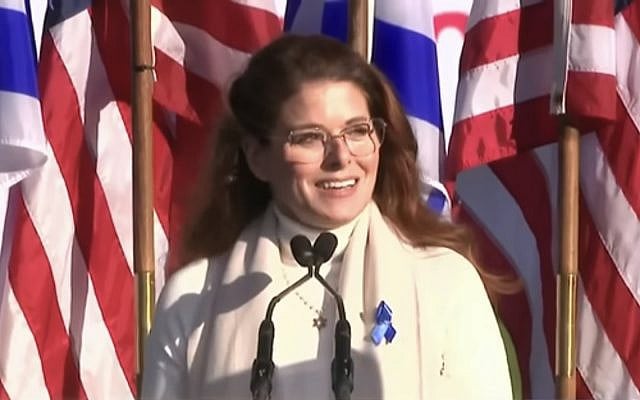
I have always believed in Palestinian dignity and rights. Not just now, and not just when it’s convenient to say so. I’ve supported a two-state solution my entire adult life. I believe the Jewish people have a right to self-determination in their ancestral homeland, just like every other people. I said all of this publicly, standing before 350,000 people, and speaking to countless more via live broadcast, at the March for Israel in Washington, DC, on November 14, 2023. These are not new convictions. They are part of who I am.
I mourn the innocent lives lost in Gaza. I pray for Palestinians to live in freedom and dignity, just as I pray for peace and safety for everyone living in Israel; Jews, Muslims, Christians, Druze, everyone. I can mourn for Palestinians and still refuse to stand alongside calls for the destruction of Israel. I will not support the extermination of any people.
God knows, I wish the October 7 massacre had never happened. And I wish, with all my heart, that Hamas had released the hostages on October 8. If they had, I believe this war and all the suffering that has followed for both Palestinians and Israelis could have been avoided.
What troubles me most is not the presence of hate. Hate has always found a way to survive. What troubles me is the way it is being rationalized. Dismissed. The way it is reframed as something noble. The way it becomes invisible, especially to those who should know better.
Jewish safety and progressive values should never be in conflict. If they are, we have to ask whether we’ve drifted from our humanity. The test is whether progressivism stands firm, not just when it is easy but when it’s hard; when it forces us to confront multiple truths.
In the end, every movement tells you who belongs by what it is willing to protect.
I still believe in the progressive vision. But I’m watching closely, because if it can’t make space for my community, then it’s not what it claims to be.
| 




.gif)





.png)
.png)